Instructions for living a life: Pay attention. Be astonished. Tell about it.

Mary Oliver

Wednesday, April 26, 2023

Consider subscribing or leaving comments!

 It is really hard to be a consistent journalist, but I've already posted over 20 times this month and it feels good!  I hope to continue to post regularly.  Next month my focus will be on issues of information literacy...there is so much misinformation out there!  It's like a jungle out there and I want to be your machete to chop your way through and untangle the overgrowth.  Some of that misinformation is so compelling; we want to believe it.  

I still believe that truth is the best way forward.

I'd appreciate your comments and support.  What worries you?  What bugs you?  What confuses you?

There's nothing that I like more than an information challenge!


April is Poetry Month: Day 22

 I still have enough poetry books on my shelves to make it to the end of the month choosing a book and sharing a poem from it, but I'd like to change it up a bit and share a poem I wrote about April.

Morning Run in April, Interrupted by a Sudden Sound. . .


Three geese, 

photo image created on BeCasso
from an original by J. Doolittle

dipping tails into 

a pond of pigment,

rise,

and with broad strokes 

paint sky where there had been none.

More join the canvas

Adding clouds 

and trees--

budding and expectant.


I forget to watch my feet.


Two robins, 

Draw a solid stripe across my path

And settle on the grass,

Green, without a doubt,

Their shadows.


                                Jean Doolittle, 1995


I wrote this while I was in a poetry class and it benefited greatly from the critiques I received.  It began overly verbose and sentimental, but we found that the heartwood was good and pruned it to discover the proper form and shape.  I hope you can feel some of the magical transition that can happen only in spring; a transformation of the land, the life upon it, and ourselves, if we simply open ourselves to the experience.  


Tuesday, April 25, 2023

April is Poetry Month: Day 21

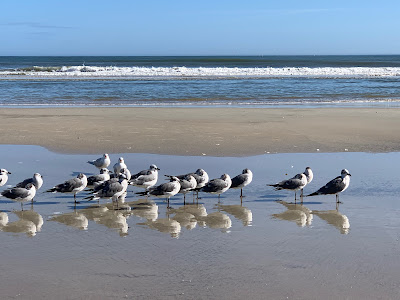
Florida, Jan 2019, J. Doolittle

What is Poetry? 

What is Poetry?  Who knows?
Not a rose, but the scent of the rose;
Not the sky, but the light in the sky;
Not the fly, but the gleam of the fly,
Not the sea, but the sound of the sea,
Not myself, but what makes me
See, hear, and feel something that prose
Cannot: and what it is, who knows?

                Eleanor Farjeon (1881-1965)


From: Pass the Poetry, Please, Lee Bennett Hopkins, Harper, 1987.  
    This is a book that I used as a teacher and the title inspired me to develop a "poetry menu" as a theme for poetry presentations I made to teachers at retreats and conferences.  It has lots of good ideas for teachers to use in their classrooms.  Rhythm and rhyme, wordplay and imagery, will always have a place in classrooms, at least I hope so.  
    Maybe we can all fit in a little more poetry into our lives...if you look it's all around you...in advertising jingles, playground chants and songs on the radio, and maybe in some neglected books on your shelf.
     I'm attaching a video of Morning Has Broken, sung by Cat Stevens (born Steven Demetre Giorgiou, and now know as Yusuf Islam) The words to this song were written as a hymn by Eleanor Farjeon, the featured poet.  She also wrote a poem that I found myself voicing out loud just tonight as we observed our cat, JJ, sleeping on the window ledge, his head resting on several stones displayed there.

    Cats Sleep Anywhere

Cats sleep, anywhere,
Any table, any chair
Top of piano, window-ledge
In the middle, on the edge,
Open drawer, empty shoe,
Anybody's lap will do,
Fitted in a cardboard box,
In the cupboard, with your frocks--
Anywhere! They don't care!
Cats sleep anywhere.

Percy, exhausted after chasing the computer mouse
Kit Kat "plants" himself in terracotta


April is Poetry Month: Day 20


Bee!  I'm expecting you!
Was saying Yesterday 
To Somebody you know
That you were due--

The Frogs got Home last Week--
Are Settled and at work--
Birds, mostly back--
The Clover, warm and thick--

You'll get my Letter
By the seventeenth; Reply
Or better, be with me--
Yours, Fly

                Emily Dickinson

From: Writing Poetry: Where Poems Come From and How to Write Them, David Kirby, The Writer, Inc, 1989.  David Kirby created a fun and accessible book on writing poetry, with lots of examples from noted poets and some of his students as well.  No doubt he's had lots of students in his 54 years at Florida State University and poetry and the teaching of it has given him lots of joy and insight.  
    I chose to feature another Emily Dickinson poem because it seemed so appropriate for our late spring which has been as anxiously awaited as Fly has anticipated Bee's return.  
    Today I introduced 20 little lettuce plants to the great outdoors to harden off for a few hours with hopes that I can put them into the garden this week and have some Black-seeded Simpson leaf lettuce to harvest in early May. (They'll be back outside again tomorrow for a little bit longer)  The winter-sowing  milk jug greenhouses that I set out in February and that spent many weeks buried under snow also have some tiny lettuce seedlings that will go into the garden in a few weeks.  Bee...I'm waiting for you too!

April is Poetry Month: Day 19

 Woodstock

I came upon a child of God
He was walking along the road
And I asked him, where are you going 
And this he told me

I'm going on down to Yasgur's farm
I'm going to join a rock 'n' roll band
I'm going to camp out on the land
And try an' my soul free
        We are stardust
        We are golden
        And we've got to get ourselves
        Back to the garden

Then can I walk beside you
I have come here to lose the smog
And I feel to be a cog in something turning
Well maybe it is just the time of year
Or maybe it's the time of man
I don't know who I am

But life is for learning
        We are stardust
        We are golden
        And we've got to get ourselves
        Back to the garden

By the time we got to Woodstock
We were half a million strong
And everywhere there was song and celebration
And I dreamed I saw the bombers
Riding shotgun in the sky
And they were turning into butterflies
Above our nation
        We are stardust
        We are golden
        And we've got to get ourselves
        Back to the garden
                            
                            Joni Mitchell, 1969


From: The Norton Introduction to Literature: Shorter Third Edition, Edited by Carl E. Bain, Jerome Beaty, J. Paul Hunter, Norton, 1982.
I didn't keep many of my college textbooks, only a couple of Norton anthologies of literature.  However, I wasn't in college in 1982; I had two small children at that time, so college wasn't a part of daily life. It must have been another addition to my bookstore that didn't sell.  This volume weighs in at 942 pages...and it's the "shorter addition!"  It was satisfying to find song lyrics from Joni Mitchell between the covers.  The poem reflects some of the naive optimism of that time..."bombers turning into butterflies" but the ideals we had back then of peace and simplicity are powerfully stated. It was also satisfying to see that she was able to return to performing at the Newport Folk Festival, 8,660 days after her last performance at the age of 55.  She had suffered a debilitating brain aneurysm that left her unable to walk or talk.  That she was able to relearn the guitar and be able to perform again at the age of 78 is amazing.  This is a woman who has been amazing...stardust and golden...her whole life!


Sunday, April 23, 2023

April is Poetry Month: Day 18

Starlings

Can you keep it so,
cool tree, making a blue cage
for an obstreperous population?
for a congregation of mediaeval scholars
quarrelling in several languages?
for busybodies marketing
in the bazaar of green leaves?
for clockwork fossils that can't be still even
when the Spring runs down?

No tree, no blue cage can contain
that restlessness. They whirr off
and sow themselves in a scattered handful 
on the grass--and are 
bustling monks
tilling their green precincts.

                            Norman MacCaig


From: Flights of Imagination: An Illustrated Anthology of Bird Poetry, compiled by Mike Mockler, Blandford, 1982.  
    The other day, my phone failed to complete an operating system download and got stuck in a verifying loop, thus requiring a trip to the Apple Store at Rosedale Center.  
    On the way back home, my daughter at the wheel and my granddaughter in the backseat, we found ourselves at a stoplight and had time to watch a "congregation" of starlings bustling around in the grass, seemingly impervious to all the busy human comings and goings on a hectic Saturday in the city.          Starlings are not native to America.  A hundred birds were first brought over and released in Central Park by Shakespeare enthusiasts in the 19th century because they wanted us to have all the birds that he had ever mentioned.  Being adaptable and assertive birds, the offspring of those original immigrants now number around 200 million birds from coast to coast.  You can learn more about them at the Cornell Ornithology Lab website.  Fascinating stuff, at least to me.  I can't begin to tell you how interesting I found this book to be...I didn't expect that reaction.  
    Over a period of about 12 years I operated an online bookstore which I called Ginger Tea Books.  It was never wildly successful, but most years, I generated a small income from it and realized some tax advantages but the actual "raison d'etre" (reason for being) was being able to go out and buy books!  I'm pretty sure this book was acquired in one of those buying trips, but never got sold and finally found a place to nest by all my other poetry books. It's going to now spend some time on the groaningly big stack of books by my bedside along with copies of Living Bird magazine. I support the Cornell Lab with donations and get their beautiful full color periodicals.  The birds of America are so diverse and learning about their habits, lifecycles and migratory adventures is eye-opening.  Our birds are citizens of the planet and their welfare and success is wedded to our own.  I hope you choose to look closer at the lives of birds in your neighborhood and become amazed and motivated to protect and preserve them.  
    Speaking of amazing...check out this video of the "murmurations" of the starlings over Rome.


Saturday, April 22, 2023

April is Poetry Month: Day 17

Hawaii, Oct, 2018, J. Doolittle

Wild Nights--Wild Nights!
Were I with thee
Wild Nights should be 
Our luxury!

Futile--the Winds--
To a Heart in port--
Done with the Compass--
Done with the Chart!

Rowing in Eden--
Ah, the Sea!
Might I but moor--Tonight--
in Thee!
                        Emily Dickinson


From: Into the Garden: A Wedding Anthology, Poetry and Prose on Love and Marriage, Edited by Robert Hass & Stephen Mitchell,  Harper Perennial, 1993.

Emily probably wrote this passionate poem when she was about 28 or 29 years old.  She never married and lived reclusively, but had a rich inner life.  The authors feature this poem in their introduction and I'm going to share their interpretation.

"I've just recently realized why this poem is so mysterious and beautiful to me.  When you first read it, you get the impression that the speaker in the poem is throwing out the charts to navigate by the freedom of her feelings in the open sea.  But it isn't so.  She has thrown them out because she is in port, in safe harbor.  And that, I saw, is what we want from each other most intimately: wildness and safety, or a magical space that includes both.  That is what is mean to row in Eden.  Dickinson herself came to believe, I think, that the dream wedding was only possible in a passionate mind, which is to say in a poem.  I don't think she thought you could have both in the real world.  It's my experience that you can have both, not all of the time but some of the time and that this possibility depends on the other more durable things that love means.  And the root of these is trust."